
Free Kerala Christian IPC matrimony
For Indian Pentecostal Church of God (IPC) families, in Kerala and around the world.
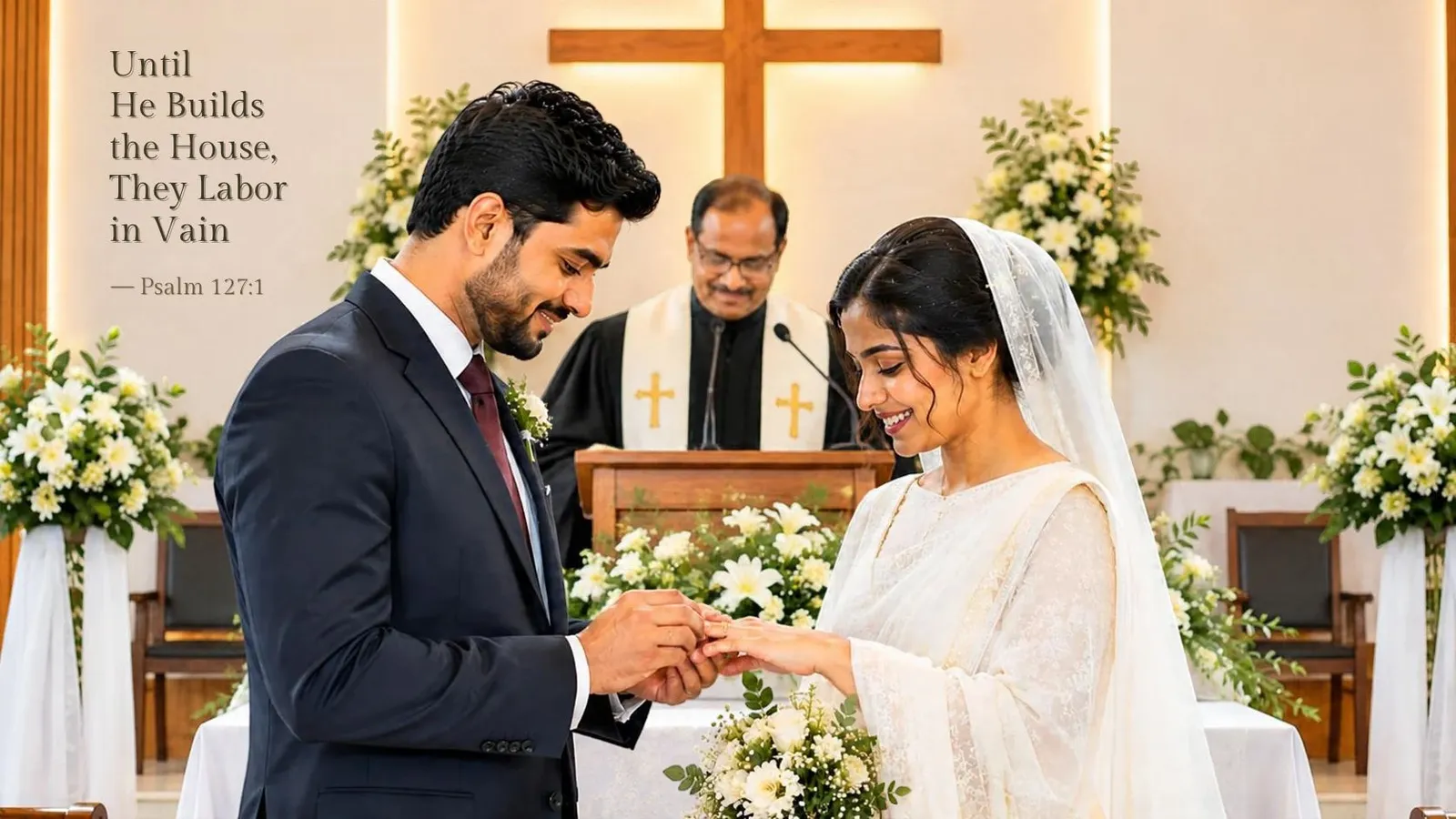
For IPC families
Families of the Indian Pentecostal Church of God can look for a partner from IPC assemblies, or from the wider Pentecostal family, and say how much that matters to them.
How matching works
When you create a profile, you choose your church and say how much a partner’s church matters to you: the same church, a related tradition, or open to any Christian partner. Recommendations respect that choice, and we explain why we suggest each person.
Your family, your pace
A parent or relative can create the profile, and it says so. You can claim it and decide what your family can do. When you connect with someone, you can include family members in your journey together, if you both agree.
Join free · How it works · FAQ
IPC Matrimony – Kerala Church History & Christian Marriage
If you grew up in an IPC family in Kerala, the name Kumbanad may bring back memories of annual conventions, prayer meetings, and gatherings with relatives and friends.
Perhaps you attended Sunday school at your local church, participated in a PYPA youth meeting, or traveled with your family to a convention where thousands gathered for worship and Bible teaching.
These experiences are part of the identity of the Indian Pentecostal Church of God (IPC), one of the major Pentecostal denominations that emerged from Kerala’s Christian revival movements during the early twentieth century.
For someone considering marriage, sharing an IPC background may provide a familiar foundation. But understanding another person’s faith, character, family expectations, and plans for the future is equally important.
The Beginning of the IPC Movement in Kerala
The history of the Indian Pentecostal Church of God is closely connected with the spiritual revival movements that spread through central Travancore during the early twentieth century.
At the time, Christian prayer fellowships were developing in villages around Ranni, Kumbanad, Mulakuzha, and neighboring areas.
These gatherings brought together people from different Christian backgrounds who were interested in Bible study, prayer, evangelism, and the Pentecostal experience of the Holy Spirit.
Early leaders included K. E. Abraham, P. M. Samuel, K. C. Cherian, P. T. Chacko, K. C. Oommen, and several other ministers and evangelists. Their work helped bring independent prayer fellowships into closer cooperation.
IPC Beliefs and Worship Traditions
The Indian Pentecostal Church of God belongs to the Pentecostal tradition of Christianity. Its statement of faith emphasizes the authority of the Bible, salvation through Jesus Christ, believer’s baptism, the baptism of the Holy Spirit, and the importance of Christian holiness.
A typical IPC worship gathering may include congregational singing, prayer, testimonies, Scripture readings, and preaching.
The church also places importance on the Lord’s Supper and participation in the local congregation. Although IPC churches share a common doctrinal foundation, worship styles and local practices may differ between congregations.
Marriage Traditions in IPC Churches
Marriage in IPC is generally celebrated as a sacred Christian covenant, with emphasis on the couple’s commitment before God.
IPC wedding services commonly include Scripture readings, congregational singing, prayer, marriage vows, a biblical message, and a pastoral blessing.
Unlike Catholic and Orthodox churches, which celebrate marriage within their respective sacramental liturgies, IPC weddings generally follow Pentecostal forms of Christian worship.
The exact order of the service may vary depending on the congregation and the pastor conducting the ceremony. Some IPC families prefer simple wedding celebrations, while others organize larger gatherings that include extended family and friends.
IPC and Other Pentecostal Matrimonial Matches
IPC Christians may also consider partners from other Pentecostal denominations, including Assemblies of God, Church of God (Full Gospel), and The Pentecostal Mission (TPM).
These churches share several important Pentecostal beliefs but have distinct histories, leadership structures, and practices. Some congregations may differ in their approaches to worship, spiritual disciplines, and church membership.
For someone considering marriage across Pentecostal denominations, it can be helpful to discuss whether both individuals are comfortable with each other’s church traditions.
IPC Matrimony for Christians Living Abroad
IPC has expanded well beyond its origins in Kerala.
Congregations and fellowships associated with IPC can be found in countries such as the United States, Canada, the United Kingdom, Australia, and across the Middle East. Many Malayali IPC families maintain close relationships with relatives and churches in Kerala.
For younger Christians raised outside India, church identity and cultural background may be experienced differently. One person may be comfortable attending Malayalam-language services and maintaining traditional family customs. Another may prefer English-language worship and have different expectations about independence, career decisions, or relocation.
These differences do not necessarily prevent a successful relationship, but they are worth discussing before marriage.
Frequently Asked Questions
What is IPC Matrimony?
IPC Matrimony refers to matrimonial searches involving members of the Indian Pentecostal Church of God, a Pentecostal Christian denomination that originated in Kerala.
Who founded the Indian Pentecostal Church of God?
Pastor K. E. Abraham is widely recognized as the principal architect of IPC. Other early leaders, including P. M. Samuel, K. C. Cherian, and P. T. Chacko, also made important contributions to the movement.
When was IPC established?
IPC developed from Pentecostal fellowships in Kerala during the early 1920s. Its first united convention was held at Ranni in April 1925, and the Indian Pentecostal Church of God was formally registered in 1935.
Where is the headquarters of IPC?
The headquarters of the Indian Pentecostal Church of God is at Hebronpuram, Kumbanad, in Pathanamthitta district, Kerala.
What is PYPA in IPC?
PYPA stands for Pentecostal Young People’s Association. It is IPC’s youth organization, encouraging Bible study, Christian fellowship, leadership, and evangelistic activities.
Can an IPC Christian marry someone from another Pentecostal denomination?
Such marriages may be possible, depending on individual convictions and applicable church requirements. Couples should discuss their religious expectations and consult their respective pastors.
Are IPC and TPM the same church?
No. IPC and The Pentecostal Mission are separate Pentecostal denominations with different histories, leadership structures, and church practices.
Can IPC Christians living abroad find matrimonial matches in Kerala?
Yes. IPC Christians living internationally may consider potential partners in Kerala, elsewhere in India, or other countries, depending on their preferences and willingness to relocate.